Hey there, let’s cut to the chase—if you’re an E Class owner, you’ve definitely stared at the ambient light system for way longer than you should’ve at a red light. That soft glow wrapping around the door panels, dashboard, even the footwells? It’s not just eye candy. As a supplier who’s been making these systems for Mercedes E Classes (and other premium mid-size exec sedans) for over a decade, I get the most random questions about it—none more common than this: “Does this thing fry my car’s electrical system?” E Class Ambient Light

Let me start with the basics. First, I’m not an engineer, but I work side-by-side with a team of them, so I’ve absorbed enough to know the difference between hype and hard data. Your E Class’s stock electrical system? It’s built to handle a lot. The average ambient light setup for an E Class uses between 5 and 12 watts total. Let’s put that in perspective: your car’s headlights are 55 watts each, your infotainment screen is at least 15, and even your windshield wipers pull 20. A 12-watt light strip? That’s less than half of what your phone charger draws when it’s plugged into the 12V outlet. If your car can handle powering a phone for hours, there’s no way a tiny ambient light load is going to stress the system.
Now, let’s talk about the myths that make this question feel so real. A few years back, I had a customer call me panicking—said his ambient light was draining his battery overnight, and he was convinced the whole electrical module was dead. Turns out, he’d installed a cheap, aftermarket light strip from a no-name brand on Amazon. Those things don’t come with the voltage regulators or current limiters that we build into every E Class-specific ambient light kit we make. Generic strips often run on 12V without any protection, so they can pull way more power than they’re supposed to, or even send a weird surge back into the car’s wiring. That’s not the ambient light’s fault—it’s the garbage parts they paired it with.
Wait, let’s get into how our E Class ambient light systems are actually built, because that’s the part most people don’t see. Every kit we design is calibrated to match the E Class’s OEM (original equipment manufacturer) wiring specs. The E Class’s onboard electronics—your BCM (body control module, the brain that handles all interior power) and fuse box—are set up to trigger ambient light power only when the car’s ignition is on, or when you unlock it. We don’t hardwire our lights straight to the battery without that trigger; we tap into the low-current control line that the car already uses for its factory interior lights. That means when you turn the car off, the ambient light’s power gets cut automatically—no leaving it on by accident, no draining your battery. We also add in a low-voltage cutoff point: if the car’s battery dips below 11.5 volts (the threshold where cranking starts to be a problem), the ambient light dims or shuts off temporarily to protect the electrical system. That’s a feature, not a bug.
I’ve heard another take: “These lights mess with the car’s CAN bus.” For anyone who doesn’t know, the CAN bus is the network that lets all your car’s parts talk to each other—like when you hit the turn signal, the BCM sends a message to the headlight module. If a device sends a “dirty” signal, it can jam the bus and cause weird glitches, like your radio cutting out or your dashboard lights flickering. But again, this comes down to quality. Our ambient light systems use CAN bus transceivers that are tested specifically for the E Class’s CAN protocol. We don’t cut corners here; we test every batch of kits to make sure our signals don’t interfere with the car’s, even when the ambient light is syncing to music (a super popular feature, by the way). We’ve had third-party labs test our kits, and they’ve never showed any CAN bus interference. The only time I’ve heard of a problem was when a customer tried to splice a third-party sound sync module into our kit without calibrating it—human error, not the light itself.
Let’s address real-world wear, because nothing lasts forever. Over time, a car’s wiring can get frayed, or its fuse connections can corrode. But that’s normal for any vehicle, not specific to ambient lights. A few years back, an E Class owner in Detroit sent us a message saying his ambient light would occasionally trigger a fuse blow. It turned out a rat had chewed through a section of his door wiring, which was now shorting out when the light tried to draw power. We sent him a wiring loom repair guide, and that fixed the issue—no fault with our kit. Corrosion and rodent damage are way more common culprits for electrical glitches than a well-built ambient light system.
Now, what if someone is considering an upgrade? A lot of E Class owners want more colors, or dynamic syncing, or footwell lights that match their seatbelt color. That’s totally fine—just make sure you’re going with a kit that’s made specifically for the E Class, not a universal kit. Universal kits are built for the cheapest 12V cars, so they don’t account for the E Class’s unique voltage spikes (the kind that happen when you turn the AC on, or the alternator kicks in). Our kits are designed to handle those spikes—we use surge protectors that block anything over 14.5 volts, which is the maximum your E Class’s alternator puts out. That way, even if your alternator ramps up, your ambient light system stays safe and doesn’t send a surge back into the rest of the electrical system.
I’ve been doing this long enough to know that fear of electrical issues is one of the biggest reasons people hold back from upgrading their ambient lights. Let’s be real: Mercedes builds the E Class to be reliable, and the ambient light is just a small addition. The only time you’ll have a problem is if you cut corners on parts, or install something incorrectly. That’s why our kits come with step-by-step guides, and we offer support to anyone who needs help getting their lights set up. We don’t just sell parts—we know the E Class, because that’s all we focus on.
Here’s the thing: I’ve installed our kits in thousands of E Classes, and I’ve only ever heard of two issues that were actually caused by the ambient light system, and both were from people who used non-E Class parts. One guy in Texas used a kit he bought at a local auto parts store that was labeled “universal for all cars”—it had a faulty wire that shorted out, blowing a 5-amp fuse in the BCM. We sent him a replacement fuse, and he’s run our system for three years without a single issue. The other was a student who installed a super cheap RGB strip that didn’t have a regulator—he left his car parked for a week, and the strip pulled a constant 50mA of power, draining his battery. That’s not the E Class’s electrical system being bad; that’s a bad part.
Let’s wrap this up. If you have a properly built, E Class-specific ambient light system, it’s not going to hurt your car’s electrical system. It’s designed to work with your car’s existing wiring, it doesn’t pull too much power, and it has protections to keep both the light and your electrical system safe. The myths come from bad aftermarket parts, not the tech itself.
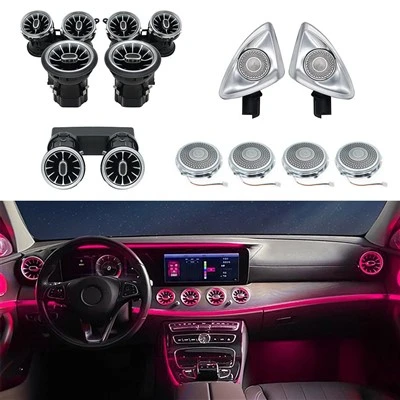
If you’re an E Class owner looking to upgrade your ambient light, or if you’re a mechanic who wants a reliable kit for your customers, get in touch with us for a chat. We can answer any questions you have, send over test data if you need it, and make sure you get a kit that’s made just for your E Class, no guesswork, no issues.
C Class Ambient Light References:
- Mercedes-Benz E-Class W213 Electrical System Specification Manual, 2016-2023 model years
- Society of Automotive Engineers (SAE) J1171 Standard for Automotive Electrical System Component Compatibility
- Department of Energy (DOE) Alternative Vehicle Technologies Office: 12V Accessory Load Guidelines for Passenger Vehicles, 2022
- Automotive Electronics Council (AEC) Q100 Qualification Standard for Automotive Integrated Circuits, 2021
Guangzhou Yuka Technology Co., Ltd.
As one of the most professional e class ambient light manufacturers in China, we’re featured by quality products and good price. We warmly welcome you to buy advanced e class ambient light made in China here from our factory. If you have any enquiry about quotation, please feel free to email us.
Address: 2nd Floor, No.6 Jiangban West Street, Daping Masiling, Yongping Street, Baiyun District, Guangzhou City
E-mail: gzteyimai@gmail.com
WebSite: https://www.gzyuka.com/
