In the realm of data centers, high – performance computing, and various industrial applications, liquid cooling has emerged as a crucial technology for managing heat. As a leading provider of liquid cooling manifolds, I have witnessed firsthand the profound influence of temperature on the performance of these essential components. This blog will delve into the intricate relationship between temperature and the performance of a liquid cooling manifold. Liquid Cooling Manifold

Principles of Liquid Cooling Manifolds
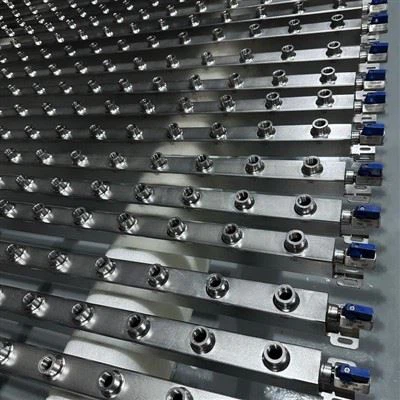
Before we discuss the relationship between temperature and manifold performance, it’s vital to understand what a liquid cooling manifold does. A liquid cooling manifold is a distribution system that channels the coolant to different parts of a cooling system. It is typically used in conjunction with heat exchangers, cold plates, and other cooling devices.
The basic working principle of a liquid cooling manifold is to evenly distribute the coolant. The coolant, usually a mixture of water and antifreeze, absorbs heat from the heat – generating components and then transfers this heat to a heat exchanger, where it is dissipated. The manifold must ensure that the coolant flow is evenly distributed across multiple cooling channels to prevent hot spots and ensure efficient cooling.
Impact of Temperature on the Flow Resistance of Liquid in Manifolds
One of the most significant effects of temperature on a liquid cooling manifold is its impact on the flow resistance of the coolant. As the temperature of the coolant changes, its viscosity also changes. Viscosity is a measure of a fluid’s resistance to flow. In general, as the temperature of a liquid increases, its viscosity decreases.
When the coolant temperature is low, the high viscosity of the coolant can lead to increased flow resistance in the manifold. This increased resistance requires more energy to pump the coolant through the system. Higher pumping energy not only adds to the operational costs but can also limit the maximum flow rate of the coolant. If the flow rate is too low, the heat transfer efficiency of the cooling system will be compromised, leading to higher temperatures in the heat – generating components and potentially reducing their performance and lifespan.
Conversely, when the coolant temperature is high, the lower viscosity of the coolant results in reduced flow resistance. This allows the coolant to flow more easily through the manifold, requiring less pumping energy. However, extremely high temperatures can also cause problems. For example, if the coolant temperature approaches its boiling point, vapor bubbles may form in the system, a phenomenon known as cavitation. Cavitation can damage the manifold and other components of the cooling system, and it can also disrupt the coolant flow, leading to uneven cooling.
Temperature and Heat Transfer Efficiency
Another crucial aspect of the relationship between temperature and manifold performance is heat transfer efficiency. The primary function of a liquid cooling manifold is to facilitate the transfer of heat from the heat – generating components to the coolant. The rate of heat transfer is influenced by several factors, including the temperature difference between the heat source and the coolant.
According to Fourier’s law of heat conduction, the rate of heat transfer is proportional to the temperature difference between the two substances. In the context of a liquid cooling manifold, a larger temperature difference between the heat – generating component and the coolant will result in a higher rate of heat transfer. Therefore, maintaining an appropriate temperature difference is essential for efficient cooling.
However, if the temperature of the coolant is too high, the ability of the coolant to absorb heat will be reduced. This is because the heat capacity of the coolant remains relatively constant within a certain temperature range. Once the coolant reaches a high temperature, it has less capacity to absorb additional heat, and the heat transfer efficiency will decrease.
Moreover, variations in temperature along the manifold can also affect heat transfer. If there are significant temperature gradients within the manifold, the coolant flow may be unevenly distributed, leading to some areas of the heat – generating component being cooled more effectively than others. This can result in local hot spots, which can damage the components and reduce the overall efficiency of the system.
Temperature – related Material Compatibility and Durability
The temperature of the coolant can also have a significant impact on the material compatibility and durability of the liquid cooling manifold. Different materials have different thermal expansion coefficients, which means they expand and contract at different rates when the temperature changes.
If the temperature of the coolant fluctuates widely, the manifold and other components of the cooling system may experience thermal stress. This stress can cause deformation, cracking, or leakage in the manifold. For example, if the manifold is made of a metal and is connected to plastic components, the different rates of thermal expansion between the two materials can lead to joint failure over time.
In addition, high temperatures can accelerate chemical reactions between the coolant and the manifold material. Some coolants may become corrosive at high temperatures, which can gradually damage the inner surface of the manifold. This corrosion can roughen the surface of the manifold, increasing the flow resistance and reducing the effectiveness of the coolant flow.
Performance Optimization Strategies Based on Temperature
To ensure the optimal performance of a liquid cooling manifold, several strategies can be adopted based on temperature considerations.
First, it is essential to maintain a stable coolant temperature within an appropriate range. This can be achieved through the use of a temperature – control system, such as a thermostat or a chiller. The temperature – control system can adjust the coolant temperature according to the heat load of the system, ensuring that the coolant is neither too hot nor too cold.
Second, choosing the right coolant is crucial. Different coolants have different temperature – viscosity characteristics and heat capacities. For applications with high heat loads, a coolant with a high heat capacity and good thermal conductivity should be selected. Additionally, the coolant should be chemically stable at the operating temperature to prevent corrosion of the manifold.
Third, the design of the manifold should take into account the expected temperature variations. For example, flexible connectors can be used to reduce the thermal stress caused by temperature – induced expansion and contraction. The internal surface of the manifold can also be treated to resist corrosion, especially in high – temperature environments.
Conclusion
In conclusion, the temperature has a profound influence on the performance of a liquid cooling manifold. Temperature affects the flow resistance of the coolant, the heat transfer efficiency, the material compatibility, and the durability of the manifold. As a liquid cooling manifold supplier, we understand the importance of these relationships and are committed to providing high – quality manifolds that can perform reliably under various temperature conditions.
Rolled Fin Stainless Steel Tube If you are looking for a reliable liquid cooling manifold solution for your application, whether it’s for a data center, a high – performance computer, or an industrial process, we are here to help. Our team of experts can provide custom – designed solutions based on your specific temperature requirements and other performance criteria. Contact us to start a discussion about your project and explore how our liquid cooling manifolds can meet your needs.
References
- Incropera, F. P., & DeWitt, D. P. (2002). Fundamentals of Heat and Mass Transfer. John Wiley & Sons.
- White, F. M. (2011). Fluid Mechanics. McGraw – Hill.
- Kakac, S., & Pramuanjaroenkij, A. (2005). Handbook of Single – Phase Convective Heat Transfer. John Wiley & Sons.
China Super Tech Co., Ltd.
As one of the most professional liquid cooling manifold manufacturers and suppliers in China, we’re featured by quality products and good service. Please rest assured to wholesale OEM liquid cooling manifold from our factory. Also, custom service is available.
Address: Wangjing Science and Technology Park, Guangshun North Street, Chaoyang District, Beijing
E-mail: sales@316liquidcooling.com
WebSite: https://www.316liquidcooling.com/
