In the vast landscape of the modern technological era, a multi-axis mount stands as a crucial yet often underappreciated component in various industries. Today, as a mounts supplier, I’m excited to take you on a deep – dive exploration of what exactly a multi – axis mount is, its functions, applications, and the significance it holds in different fields. Mounts

What is a Multi – Axis Mount?
A multi – axis mount is a mechanical device designed to provide movement and positioning capabilities along multiple axes. In simple terms, it allows an object to be adjusted and oriented precisely in different directions. The "axes" in a multi – axis mount typically refer to the different directions in a three – dimensional space, such as the X, Y, and Z axes in a Cartesian coordinate system, along with rotational axes like pitch, yaw, and roll.
These mounts are engineered with a high level of precision. They usually consist of a series of joints, bearings, and adjustment mechanisms that work together to offer smooth and accurate movement. The number of axes that a multi – axis mount can support varies depending on its design and intended use. Some basic models may only have two axes, providing movement in two directions, while more advanced ones can have up to six axes, offering a full range of movement in three – dimensional space.
The Inner Workings of Multi – Axis Mounts
Understanding how a multi – axis mount operates requires a look at its key components. The joints are the heart of the mount, allowing for angular movement. These joints can be of different types, such as ball joints or hinge joints, each with its own advantages in terms of range of motion and stability.
Bearings are another essential part. They reduce friction between moving parts, ensuring that the adjustment is smooth and that the mount can maintain its position accurately. The quality of the bearings used in a multi – axis mount directly impacts its performance and lifespan.
The adjustment mechanisms vary widely. They can include screws, gears, or motors. Screw – based adjustment systems are common in manual multi – axis mounts. By turning a screw, the user can precisely control the movement of the mount along a particular axis. On the other hand, motor – driven multi – axis mounts offer automated adjustment. These are often used in applications where rapid or remote adjustment is required, as they can be controlled by a computer or other automated systems.
For example, in a two – axis mount with a screw – based adjustment system for a small telescope, the user can turn two different screws to move the telescope horizontally (along the X – axis) and vertically (along the Y – axis). Each turn of the screw will result in a specific, small movement, allowing for fine – tuning of the telescope’s position.
Applications in Different Industries
The versatility of multi – axis mounts makes them indispensable in a wide range of industries.
Astronomy
In astronomy, multi – axis mounts play a vital role in telescope systems. They allow astronomers to track celestial objects as they move across the sky. A high – quality multi – axis mount can compensate for the rotation of the Earth, ensuring that the telescope remains pointed at the target object accurately. This is crucial for long – exposure observations, where even the slightest deviation can result in blurry images. For example, a research – grade telescope may use a six – axis mount to provide precise positioning in all directions, allowing for detailed studies of distant galaxies and nebulae.
Photography and Filmmaking
Photographers and filmmakers also rely on multi – axis mounts to achieve the perfect shot. Camera mounts with multiple axes of movement enable them to adjust the angle, tilt, and pan of the camera easily. This is especially important in dynamic shooting scenarios, such as action sports photography or film production on location. A three – axis camera mount can be used to create smooth, fluid camera movements, adding a professional touch to the final product.
Manufacturing and Automation
In the manufacturing industry, multi – axis mounts are used in robotic arms and automated machinery. They allow robots to perform complex tasks with high precision. For instance, in a semiconductor manufacturing plant, a multi – axis mount can be used to position a robotic arm precisely over a silicon wafer, enabling accurate etching or deposition processes. This not only improves the quality of the products but also increases the efficiency of the manufacturing process.
Medical Field
In the medical field, multi – axis mounts are used in various devices, such as surgical robots and imaging equipment. Surgical robots equipped with multi – axis mounts can perform minimally invasive surgeries with greater precision and control. The surgeon can use the mounts to manipulate the robotic arms in different directions, accessing hard – to – reach areas of the body. Similarly, in medical imaging, multi – axis mounts are used to position the imaging sensors accurately, ensuring high – quality diagnostic images.
Advantages of Using Multi – Axis Mounts
The use of multi – axis mounts offers several significant advantages.
Precision Positioning
One of the most prominent advantages is the ability to achieve precise positioning. In many applications, such as scientific research and high – end manufacturing, even the slightest error in positioning can lead to significant problems. Multi – axis mounts allow for adjustments in increments as small as fractions of a degree or millimeter, providing the necessary accuracy for these critical applications.
Flexibility
Multi – axis mounts provide a high degree of flexibility. They can be adapted to different objects and applications. For example, a single multi – axis mount can be used to position a small optical component in a laboratory one day and then be reconfigured to hold a larger industrial part in a manufacturing setting the next. This adaptability makes them a cost – effective solution for many businesses.
Improved Efficiency
In automated systems, multi – axis mounts can greatly improve efficiency. By providing rapid and accurate positioning, they can reduce the time required for tasks. In a manufacturing process, this can lead to higher production rates and lower costs. For example, a robot with a multi – axis mount can perform a series of assembly tasks faster and more accurately than a manual worker.
Choosing the Right Multi – Axis Mount
Selecting the appropriate multi – axis mount for a specific application is crucial. Several factors need to be considered.
Load Capacity
The load capacity of the mount is an important consideration. It refers to the maximum weight that the mount can support without compromising its performance. If the load capacity is too low, the mount may not be able to hold the object securely, leading to inaccurate positioning or even damage to the mount. For example, a heavy – duty industrial camera may require a multi – axis mount with a high load capacity.
Range of Motion
The range of motion of the mount along each axis is also significant. Different applications may require different ranges of movement. For instance, in astronomy, a telescope mount may need a wide range of motion to track celestial objects across the sky. On the other hand, a microscope mount may only need a limited range of motion for fine – tuning the position of the specimen.
Accuracy
The accuracy of the mount is another critical factor. It is usually measured in terms of angular or linear resolution. Higher accuracy is required for applications such as precision machining or scientific research. A mount with high accuracy can ensure that the object is positioned within a very small tolerance, which is essential for achieving high – quality results.
Environmental Conditions
The environmental conditions in which the mount will be used also need to be taken into account. For example, in a harsh industrial environment with high levels of dust and moisture, a mount with good sealing and corrosion – resistant materials may be required. In a cleanroom environment, a mount that produces minimal particles and has low outgassing properties is necessary.
As a Mounts Supplier
As a mounts supplier, I understand the diverse needs of our customers across different industries. We offer a wide range of multi – axis mounts, from basic two – axis models for hobbyist applications to advanced six – axis mounts for high – end research and industrial use. Our mounts are designed and manufactured with the highest quality standards, using the best materials and the latest manufacturing techniques.
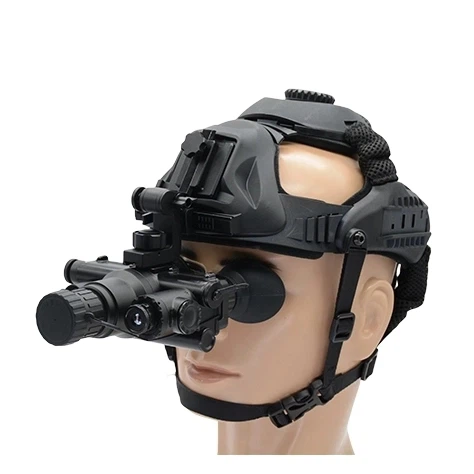
We also provide comprehensive technical support and customization services. Our team of experts can help you choose the right mount for your specific application and can even modify our standard mounts to meet your unique requirements. Whether you are a small business looking for an affordable solution or a large corporation in need of a high – performance mount, we are committed to providing you with the best products and services.
Thermal Binocualars If you are in the market for a multi – axis mount, I encourage you to reach out to us. We would be more than happy to discuss your needs, provide detailed product information, and offer competitive pricing. Our goal is to help you find the perfect multi – axis mount that will enhance the performance and efficiency of your operations.
References
- Smith, J. (2018). Precision Mechanisms: Design and Applications. Publisher XYZ.
- Johnson, A. (2020). Multi – Axis Motion Control in Industrial Automation. Journal of Automation Technology, Vol. 15, Issue 2.
- Brown, C. (2019). Astronomy Instrumentation: Telescope Mounts and Their Function. Astronomy Research Quarterly, Vol. 22, Issue 3.
Shenzhen Detyl Optoelectronics Co., Ltd.
With abundant experience, we are one of the most professional mounts manufacturers and suppliers in China. Please rest assured to buy customized mounts at competitive price from our factory. For pricelist and quotation, contact us now.
Address: 4th Floor, Building 3, Factory, No. 20, Second Industrial Avenue, Tangxiayong Community, Yanluo Street, Bao’an District, Shenzhen
E-mail: sales@detyl.com
WebSite: https://www.detyl.net/
